Murals 1
The New York Mural Cycles by Craig McPherson
From 1985 to 1992, Craig McPherson spent seven years working on two monumental mural projects commissioned by the American Express Company for their corporate headquarters at 200 Vesey Street, Brookfield Place (World Financial Center) in Manhattan. These included Harbors of the World, a 318-foot cycle for the main lobby, completed over five years from 1987-92, and Twilight: The Waterways and Bridges of Manhattan, a 90-foot mural cycle of four paintings for the auditorium, completed in 1985-86.
Independent curator and art historian, John Arthur, contributed these comments on the mural cycle after it was unveiled.
"For sheer bravura, sublime appropriateness, and true monumentality, Craig McPherson’s Harbors of the World must rank as one of the greatest contemporary achievements in public art."
Harbors of the World Mural Cycle, New York Murals & McPherson murals survive 9/11
More »The New York Mural Cycles by Craig McPherson
From 1985 to 1992, Craig McPherson spent seven years working on two monumental mural projects commissioned by the American Express Company for their corporate headquarters at 200 Vesey Street, Brookfield Place (World Financial Center) in Manhattan. These included Harbors of the World, a 318-foot cycle for the main lobby, completed over five years from 1987-92, and Twilight: The Waterways and Bridges of Manhattan, a 90-foot mural cycle of four paintings for the auditorium, completed in 1985-86.
Independent curator and art historian, John Arthur, contributed these comments on the mural cycle after it was unveiled.
"For sheer bravura, sublime appropriateness, and true monumentality, Craig McPherson’s Harbors of the World must rank as one of the greatest contemporary achievements in public art."
Harbors of the World
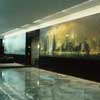
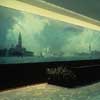
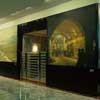
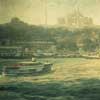
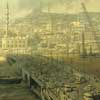
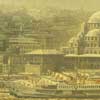
This commissioned series, titled Harbors of the World, by the artist Craig McPherson is composed of ten oil-on-linen paintings over 11 feet high and 318 feet in length, with six large paintings over 40 feet long. These paintings comprise one of the largest mural cycles in New York and series of cityscapes in the U.S. The project involved working on site in New York, Venice, Istanbul, Hong Kong, Sydney and Rio de Janeiro for 14 months, followed by four years of studio work in New York. The murals are on permanent view at 200 Vesey Street, Brookfield Place, in the American Express Company’s mezzanine lobby
In the 1993 catalog for Craig McPherson’s one-man show following the installation of the harbor murals, John Arthur wrote this commentary.
"These gargantuan murals point out the fact that New York is a multicultural harbor city of immigrants, and they also serve as a reminder that we now exist in a global economy. While they are clearly symbolic and referential, McPherson’s panoramic views of New York, Venice, Istanbul, Sydney, Rio De Janeiro and Hong Kong also thematically represent the continents and seasons, and traverse both space and time… Perhaps the greatest strength of these murals is that the painter has managed to maintain the physical character and ambience of each of these legendary cities and instill each panorama with a sense of drama and mystery."
The review continues,
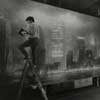
"Each of the six panoramic views is based on a schematic drawing executed to scale during a two-to-three month stay in each of the cities. In order to do the schematic drawings on site, McPherson devised a method of representing a broad radial view through his highly innovative use of a surveyor’s theodolite. Later, working over the grisaille under paintings, he avoided the major pitfalls of an anemic surface and impersonal rendering, by painstakingly building up a rich, chromatic surface of sanded, scraped and glazed layers of paint that achieves the richness of a fully realized easel painting. Importantly, he has also calculated for the eventual translucence and luminosity of the fully-aged oxidation of the oils."
Historical Note: McPherson Murals Survive 9/11
The global and historic significance of the Harbors of the World paintings has been made even more poignant by recent events. Following the first attack on the World Trade Center (WTC) in 1993, the American Express lobby was used as a triage center for the injured. On September 11, 2001 the North Tower of the WTC, directly across West Street from the American Express building, was once again attacked and fell into ruin. The force of the blast from the collapse of the North Tower blew in the windows and filled the AmEx lobby with dust and debris. The Harbor murals encircling the mezzanine took the force of the blast. For many months the paintings were encased in wet cement debris, while being exposed to the elements and the acrid smoke billowing from Ground Zero. Under such conditions it was unlikely that the murals would have survived.
Yet, they did, and relatively unscathed. The team of hazmat-suited conservators hired to do the final water cleaning commented afterwards, that the paintings’ remarkably fine condition could be attributed to McPherson's technical skill at producing an extremely tough paint film. No paint retouching was required.
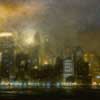
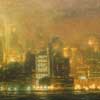
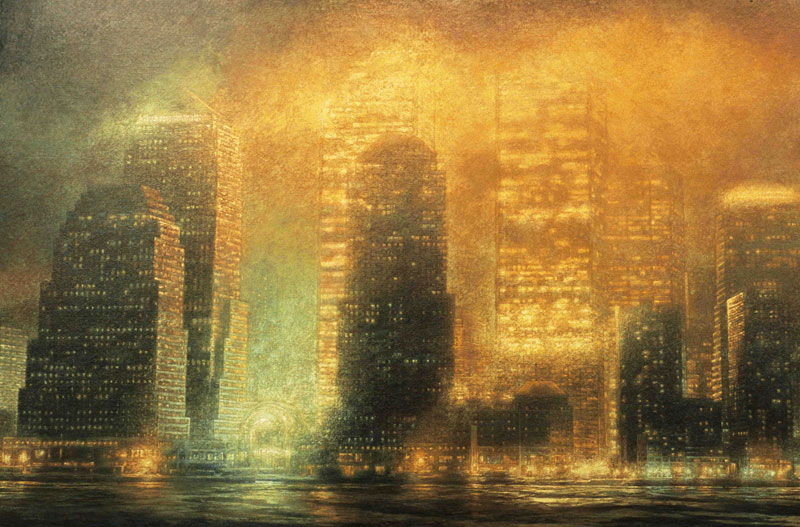
At the time of the Harbor mural's creation, from 1988 - 1992, it would never have occurred to anyone that the American Express building or paintings might be in peril. Subsequent events have heightened the art’s historic value, particularly since the New York mural depicts the World Trade Center’s Twin Towers in a panoramic view of lower Manhattan. The towers are shown in winter, at night, when a snow storm has obscured the upper portion of the buildings. Enveloped in a cloud of reflected light, the Twin Towers are eerily reminiscent of images we are now so familiar with from 9/11. These NYC murals’ history and location are forever linked with the events of 9/11. Now it has become another 911 Memorial for those who have passed and those visiting the site.
In conclusion, Arthur writes,
"While he is a masterful draftsman and dazzling technician, an aspect that has been so vividly demonstrated in his mezzotints, paintings and murals, importantly, McPherson understands that such skills are no more than tools to employ in striving towards an image that is rich in substance and resources. Like the printmaker Martin Lewis, he is attracted to the transformation of mundane urban incidents into heightened enigmas that occur by setting them in the dark ambiguities of night. And like Lewis, he is proven to be above all else a conjurer of ambience. From the smallest studies to his monumental murals, Craig McPherson’s extravagantly rendered views are cloaked in shadowy mysteries, and it is the lingering impressions of their moods that live in our memory."
FAQs:
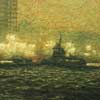
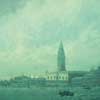
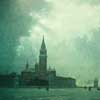
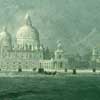
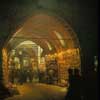
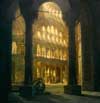
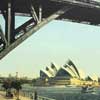
The Harbors of the World reflect their location on the waterfront in New York. They are thematically-related, traversing the globe from the northern hemisphere to the south, east and west. In keeping with their role as public art and due to the nature of their corporate sponsor, American Express, the paintings convey the dynamic energy of contemporary harbor cities, cultural diversity, the allure of world travel, trade and commerce. The horizontal format is perfectly suited for large panoramas, within which McPherson details all manner of art references and engaging vignettes. The Harbors of the World mural cycle is composed of ten paintings: New York, February, Night, 11.3 x 42.6 feet, and Venice, April, Early Morning, 11.3 x 42.6 feet. These harbor views on the AmEx Tower’s north walls represent two of the northern hemisphere’s great trading and financial capitals, both historic and modern. A triptych of Istanbul and the Golden Horn on the east walls is composed of Istanbul, July, Mid- Morning, 11.3 x 51.8 feet, with two pendant panels illustrating interior views, Covered Bazaar and Haghia Sophia, Interior, both 11.3 x 10.8 feet. The mezzanine’s south walls face the high arch of the Brookfield Palm Court. These panels depict the southern hemisphere with one continuous elliptical curve linking Sydney, December, Early Afternoon, 11.3 x 42.6 feet and Rio de Janeiro, March, Later Afternoon, 11.3 x 42.6 feet. Finally, on the west walls representing Asia, a triptych of the Hong Kong harbor includes the steep diagonals of the Peak overlooking the South China Sea and the city’s glittering buildings, markets and ships. This group is composed of: Hong Kong, October, Twilight, 11.3 x 51.8 feet; Pottinger Street outdoor market, 11.3 x 10.8 feet and the container ship, The Shaplaeverett, both 11.3 x 10.8 feet
Twilight: The Waterways and Bridges of Manhattan
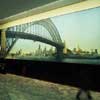
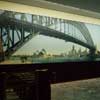
The first American Express mural cycle is composed of four paintings titled, Twilight: The Waterways and Bridges of Manhattan. The paintings include views of the Hudson River, Harlem River, East River and harbor. A chromatic scale transitioning across all four paintings, from a luminous pale yellow in the west to a deep saturated blue in the east, forms one continuous atmospheric band of light depicting a city dweller’s view during the evanescent time of twilight. Designed for a completely enclosed space, the paintings pierce the walls with dramatic openings in four directions, each unique, yet unified by McPherson for the subdued light of the auditorium.
The four oil-on-linen paintings in the Twilight mural cycle are: The Hudson River, 6 x 35 feet; The Harlem River, 6 x 10 feet; The East River, 6 x 15 feet; and The Harbor, 7 x 30 feet. These are not on public display.